


Tristan Schwekendiek

I'm a Developer roles: IT Professional, Frontend Developer, Backend Developer, Agentic AI Developer

Education

  1. Year One

    Georgian College

    Georgian College

    Computer Programming Diploma

    Built a foundation in programming, databases, web development, and software design.

  2. Year Two

    Georgian College

    Georgian College

    Computer Programming Diploma

    Completed the diploma program and prepared to continue into advanced computer science studies.

  3. Co-op

    Weber Manufacturing

    May 2024 to August 2024

    Weber Manufacturing

    Information Technology Professional / Software Engineer

    Automated workflows with Power Automate and PowerShell, managed Azure, Microsoft 365, and Intune environments, and built Python cybersecurity monitoring tools.

  4. Year Three

    Lakehead University

    Lakehead University

    Honours Bachelors in Computer Science

    Continued into honours-level computer science with advanced work in algorithms, systems, networking, and security.

  5. Year Four

    Lakehead University

    Lakehead University

    Honours Bachelors in Computer Science

    Expanded into cloud computing, artificial intelligence, data science, and upper-year software development.

Relevant Courses

Building on the concepts from Introduction to Object-Oriented Programming, students utilize techniques that enable the creation of more sophisticated and complex applications. Students explore deeper applications for the Java programming languages, such as mobile applications and Graphical User Interface (GUI) design and construction.

View official course listing

The use of client-side scripting to implement interactive behaviour within the browser environment is an important part of modern web applications. Standard client-side scripting syntax, operations, conditional statements, loops, functions, methods, and objects are examined. Students learn to manipulate the standard Document Object Model (DOM), by modifying the structure (HTML) and the appearance (CSS) of Web pages and/or interfaces for the purposes of improving the user experience.

View official course listing

In this course, students learn how to plan, analyze, design, and implement IT projects. Through the course content, students focus on the Systems Development Life Cycle (SDLC) as well as formal Project Management processes, such as scope, quality, risk, and resource management. Emphasis is placed on the practical application of software tools to design and manage IT projects.

View official course listing

Students are introduced to the process of planning, creating and managing a relational database using Structured Query Language (SQL) statements. Students apply best practices such as the use of entity relationship diagrams (ERD). Normalization and atomicity, consistency, isolation, durability (ACID) are emphasized. Students also develop skills in data manipulation and extraction.

View official course listing

In this course, students learn how to use Python programming language to solve common programming problems that involve the automation of tasks, such as reading and manipulating word processing files, spreadsheets and web data, as well as scheduling tasks and launching programs.

View official course listing

Design principles meet Web standards and aesthetic challenges in this practical interface design course. Students learn about advanced CSS selectors, CSS normalization, page layout techniques, interactive interface elements, colour, typography, and a variety of CSS-based visual effects. Responsive design fundamentals that address a variety of screen-rendering contexts are also addressed.

View official course listing

Network systems interconnect computer related resources, services and users. Students gain fundamental knowledge of networking concepts and technologies. There is a strong emphasis on terminology, protocols, error detection/correction and network security. Students develop the necessary skills to plan and implement small networks across a range of applications.

View official course listing

Students learn to use the Object Oriented Programming principles of encapsulation, polymorphism and inheritance in the C++ programming language. Students obtain knowledge of C++ grammar and syntax. Emphasis is placed on the powerful programming techniques supported by C++, including object manipulation and reusability, function/operator overloading, pointers and dynamic memory allocation.

View official course listing

In this course, students are introduced to new cloud solutions. Students learn to describe many cloud services such as Data Warehouses, Containers, Kubernetes, and Cloud Functions, and how to administer security solutions in the Cloud, such as Security Center and cloud firewalls.

View official course listing

The design and analysis of data structures and algorithms including Stacks, Link Lists, Trees, Graphs, Searching, Sorting and their complexity analysis. The theory is reinforced by working examples, laboratories, projects, and the use of abstract data types from the C and C++ standard libraries.

View official course listing

Digital logic. Digital systems. Machine-level representation of data. Major component parts of a modern digital computer, namely, control unit, arithmetic and logic units, memory units and peripheral interfaces are studied.

View official course listing

Introduction to artificial intelligence (AI) and its applications. Topics include several of the following: logic and reasoning, AI languages, state-space search, heuristics, constraints-satisfaction problem, game-problem solving, planning, machine learning, agent and multi-agents programming, neural networks, genetic algorithms and reasoning about uncertainty. Students will design and implement a medium scale project related to game programming as part of the course requirements.

View official course listing

Design of algorithms and analysis of required time and space resources for execution. Lower bounds for resource requirements. Problems in arithmetic, order statistics, set manipulation, string matching, graph theory. Polynomial time, P, and non-deterministic polynomial time, NP, computable algorithms. NP complete problems.

View official course listing

An introduction to the concepts of Computer Networks: LAN, WAN, communication protocols, inter-process communication/synchronization. Concurrent programming and distributed systems. Real-time systems.

View official course listing

Topics include conventional encryption, public-key cryptology, authentication and digital signatures, key distribution, IP security, web security, and network management security.

View official course listing

Processes and device handlers and their implementation, communication and synchronization. Synchronization primitives. Process allocation. Memory management. The software required to support a virtual memory system. Resource allocation algorithms. File system implementation. Security and protection. System implementation strategies. The evolution of computer systems: batch processing, multiprogramming, multi-processing, real-time, time-sharing, distributive systems. Each student will design and implement a module for an operating system kernel.

View official course listing

An introduction to the main tools and ideas in the data scientist's toolbox. An overview of the data, questions, and tools that data analysts and data scientists work with. There are two components to this course. The first is a conceptual introduction to the ideas behind turning unstructured data into actionable knowledge. The second is a practical introduction to the tools that are commonly used in Data Science such as R and Python.

View official course listing

This course discusses the key cloud concepts of: (i) Infrastructure as a Service (IaaS), (ii) Platform as Service (PaaS), and (iii) Software Application as Service (SaaS), as well as new and contemporary trends in cloud computing. It also expose students to concepts and technologies related to cloud computing such as Virtualization, Cloud Computing Platforms, Public Cloud, Private Cloud, Hybrid Cloud and Community Cloud Deployment Models, Business Cost Metrics and Formulas for Comparing and Calculating Cloud and On-Premise Solution Costs and Service Level Agreements (SLAs) for Cloud-based IT Resources. Selecting a cloud environment and deploying/implementing cloud based applications will be among the student projects/assignments of this course.

View official course listing

Work Experience

Weber Manufacturing logowebermfg.ca

Information Technology Professional / Software Engineer

May 2024 - Aug 2025, May 2025 - Aug 2025

  • Developed and implemented automation solutions using Power Automate and PowerShell scripting to streamline workflows and reduce manual intervention, improving efficiency and accuracy in various IT operations.
  • Managed enterprise environments in Microsoft Azure and Microsoft 365, leveraging Intune to deploy, monitor, and maintain company applications and devices.
  • Created a Python-based web scraping application to monitor and manage cybersecurity threats, contributing to the overall security posture of the organization.

Algorithmics logoalgorithmicschool.com

Computer Science Instructor

Jan 2025 - Present

  • Taught Python programming and introductory Artificial Intelligence concepts through live online classes, helping students develop coding proficiency and real-world project experience.
  • Guided students in building software projects using industry-standard programming practices, including debugging, algorithm design, and object-oriented programming principles.
  • Managed virtual classrooms and delivered personalized technical coaching, resulting in improved student engagement, project completion rates, and coding confidence.

Portfolio

Mar 2026

Discord Dice Bot

View project on GitHub
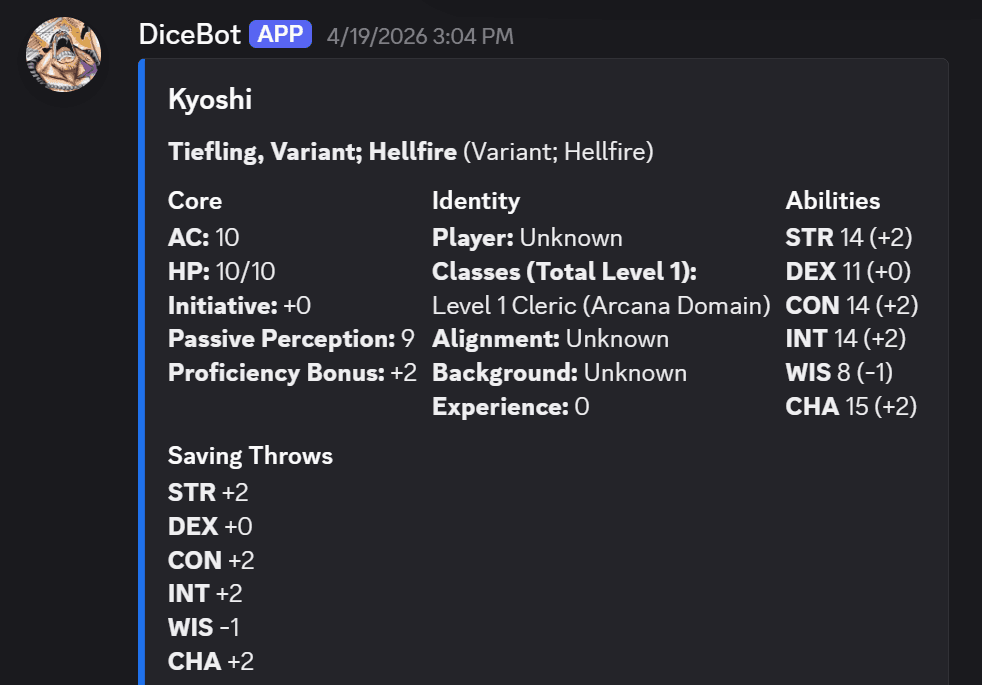
  • Engineered a feature-rich Discord bot in Node.js for a Dungeons and Dragons game system, implementing initiative tracking, death saves, spellcasting, spell slots, rest mechanics, inventory, and class-specific resource management through a custom command architecture.
  • Designed and extended a flexible character data model to support multiclassing, class-specific spellbooks and loadouts, dynamic stat calculation, and JSON-based character import and export for persistent player profiles.
  • Built scalable game-data integrations using external JSON sources for spells, races, classes, and subclasses, enabling automated command responses, structured embeds, and a foundation for a companion web-based character creator.
Discord Dice Bot character sheet response

In development

Pokémon Platinum Decompilation Modernization

WIP

  • Extended an existing Pokémon Platinum decompilation in C, working within established battle, AI, interface, data, and scripting systems instead of an isolated greenfield application.
  • Implemented and ported modern move and ability mechanics by modifying core battle controllers, engine headers, script commands, assembly-driven resources, and generated game data while preserving the architecture of the original stack.
  • Integrated changes with the project's existing Meson and Ninja ROM build pipeline, adapting behavior from an external engine reference to fit Pokémon Platinum's technical constraints and established conventions.
Pokémon Platinum Version Nintendo DS cover art